Building materials suppliers play an important role in residential construction, commercial projects, infrastructure development and property maintenance across Saudi Arabia and the Gulf countries. From cement and steel to tiles, pipes, electrical supplies, paint and hardware, suppliers often manage hundreds or thousands of products with different costs, quantities, suppliers and selling prices.
As a building materials business grows, keeping track of inventory using notebooks or spreadsheets becomes increasingly difficult. Products may be purchased in bulk, sold in different quantities, delivered to customers at different times, or supplied on credit. Without organized records, stock discrepancies, overdue payments and purchasing mistakes can affect cash flow and profitability.
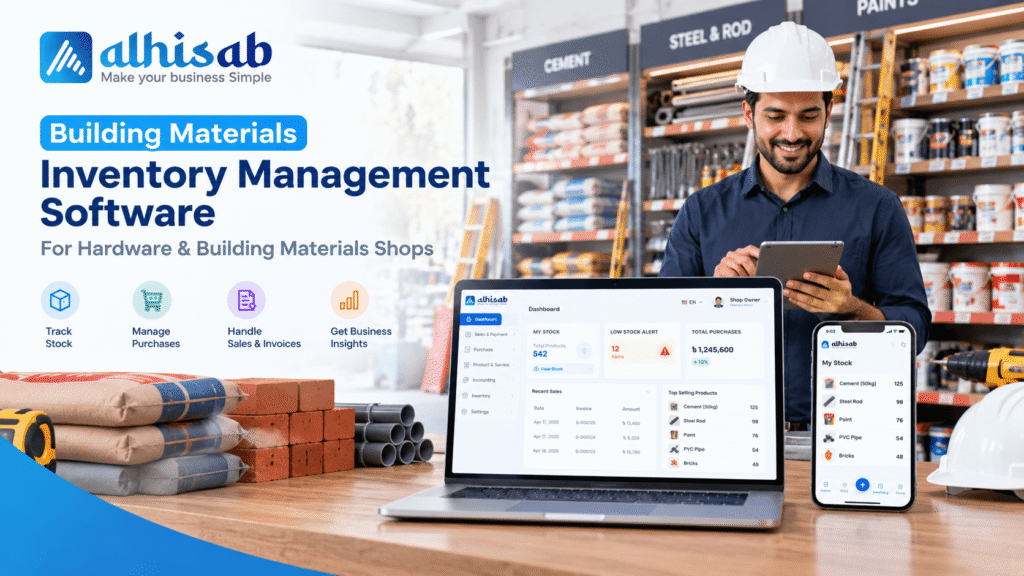
Building materials inventory management software helps suppliers organize product records, track purchases and sales, monitor inventory and maintain customer, supplier and accounting records in one system.
Alhisab combines inventory management, sales, purchases, accounting, customer and supplier management, and business reporting. It can be considered by building materials suppliers, hardware retailers and construction supply businesses in Saudi Arabia, the UAE, Qatar, Kuwait and Oman that want to manage their everyday business operations digitally.
Why Do Building Materials Suppliers Need Inventory Management Software?
Building materials businesses often handle a wide range of products, from high-volume materials such as cement and sand to higher-value items such as steel products, tiles, electrical equipment and plumbing supplies.
Different products may have different storage requirements, purchasing costs, sales units and supplier arrangements. A business might purchase one product in bulk while selling it in smaller quantities, depending on its customers and trading practices.
When records are maintained manually, common problems include:
- Inaccurate stock quantities.
- Difficulty identifying which products need replenishment.
- Confusion between similar products, brands, sizes and specifications.
- Incomplete purchase and sales records.
- Difficulty tracking customer credit and supplier balances.
- Poor visibility into product costs and business expenses.
- Difficulty determining how much capital is tied up in inventory.
- Time-consuming preparation of sales, purchase and financial reports.
Inventory management software helps businesses maintain structured product and transaction records, making it easier to review stock, purchases, sales and financial information.
1. Manage Different Types of Building Materials in One System
A building materials supplier may sell products from several categories, including:
- Cement and construction chemicals.
- Steel bars, rods and metal products.
- Sand, aggregates and related materials.
- Ceramic and porcelain tiles.
- Pipes, fittings and plumbing supplies.
- Electrical cables, switches and accessories.
- Paints, coatings and waterproofing products.
- Doors, windows and building hardware.
- Tools, fasteners and other construction supplies.
Each product needs accurate identification and purchasing and sales records. Similar items may have different brands, specifications, sizes or prices, making an organized product catalog important.
Alhisab provides product and inventory management capabilities that businesses can use to organize their stock records. Product categories, subcategories, brands and variations can help create a more structured catalog.
For example, a hardware supplier can organize different types of pipes, fittings, electrical products and tools so employees can locate the correct product more easily when recording purchases or sales.
A well-organized product catalog also makes it easier to review product-level inventory and sales information.
2. Track Stock Quantities and Inventory Value
Knowing how much stock a business owns is essential for purchasing decisions and day-to-day operations.
If the inventory records are inaccurate, a supplier may accept an order for materials that are unavailable or purchase additional stock unnecessarily. Both situations can create operational problems and affect cash flow.
Alhisab provides inventory information, including stock quantities and stock value, along with product and purchase-related reports.
These records can help suppliers review:
- Available stock quantities.
- Inventory value.
- Product-level stock information.
- Purchase and sales activity.
- Products that may require replenishment.
- Stock movement associated with recorded transactions.
For example, a supplier can review the available inventory of a particular tile model before accepting a large order. The owner can also examine purchasing and sales records when deciding whether to replenish that product.
Accurate inventory information depends on recording purchases, sales, returns and stock adjustments correctly.
3. Organize Different Product Sizes, Brands and Variations
Building materials frequently come in different sizes, specifications and brands.
For example, a tile retailer may stock several tile dimensions and designs. A hardware supplier may carry different pipe sizes, while an electrical supplier may sell cables with different specifications.
If similar products are recorded under unclear or inconsistent names, employees may select the wrong item or make mistakes when recording a transaction.
Alhisab supports product variations, which can help businesses organize different versions of a product within their inventory structure.
This can be useful for retailers that need to distinguish products by attributes such as size, color or other variations supported by their product setup.
A structured catalog helps staff identify products more consistently and allows the business to maintain clearer product records.
Important consideration: Building materials are often traded in units such as pieces, bags, boxes, meters, kilograms, tons or cubic meters. Before selecting any inventory system, confirm that it supports the exact units, conversions and fractional quantities your business needs. Do not assume that product variations automatically provide automatic unit conversion.
4. Manage Bulk Purchases and Supplier Records
Building materials suppliers often purchase products in substantial quantities from manufacturers, importers, wholesalers and distributors.
Maintaining accurate purchase records helps businesses understand how much stock they have acquired, how much they have spent and how much they still owe their suppliers.
Alhisab includes purchase management and supplier records, allowing businesses to organize purchasing transactions and maintain supplier ledgers.
These records can help answer practical questions:
- Which products were purchased from a supplier?
- How much was spent on a particular purchase?
- What payments have been recorded?
- How much remains payable to a supplier?
- What purchasing activity occurred during a selected period?
When purchases are recorded alongside inventory and accounting, suppliers can review stock and financial information without maintaining entirely separate records for each activity.
For businesses purchasing materials from multiple suppliers, organized purchase histories can also support better purchasing decisions.
5. Record Sales to Contractors, Retailers and Other Customers
Building materials suppliers may sell to individual homeowners, construction contractors, property developers, maintenance companies, hardware retailers and other businesses.
Some customers pay immediately, while others may purchase on credit or make payments in stages.
Alhisab provides sales management and customer records to help businesses organize these transactions. Customer ledgers can also help maintain a history of recorded transactions and outstanding balances.
This can be particularly useful when a supplier needs to review previous transactions before processing a repeat order or following up on an outstanding payment.
With organized sales records, businesses can review customer transactions, product sales and related business information in one system.
If your business requires specialized construction-project billing, contract-based pricing, progress invoicing or automatic delivery scheduling, confirm that the relevant workflows are supported before implementation.
6. Monitor Customer Credit and Outstanding Dues
Credit sales are common in many wholesale and building materials businesses. A supplier may deliver materials to a contractor or retailer and receive payment later.
Without accurate records, the business may struggle to determine which customers have outstanding balances, how much has been paid and what remains due.
Alhisab includes customer ledger and due-management functionality to help businesses maintain transaction histories and monitor outstanding customer balances.
This can help suppliers answer questions such as:
- How much does a particular customer owe?
- What transactions make up the outstanding balance?
- Which payments have been recorded?
- What is the customer’s transaction history?
Clear customer records can help businesses follow up on outstanding payments and make better-informed decisions about extending credit.
However, software records alone do not guarantee payment. Businesses should also establish appropriate credit limits, payment terms and collection procedures.
7. Track Supplier Dues and Manage Cash Flow
Building materials businesses may have significant amounts of money tied up in inventory, customer credit and supplier payments.
A business can appear busy while experiencing cash-flow pressure if customers pay late or too much capital is committed to slow-moving products.
Alhisab’s accounting and supplier ledger functionality helps businesses organize payments, supplier balances and other financial records.
By reviewing customer receivables, supplier payables, expenses and cash or bank records, business owners can develop a clearer picture of their recorded financial position.
For example, before placing a large purchase order, an owner can review outstanding customer balances and supplier obligations alongside available financial information.
This does not replace cash-flow forecasting or credit-risk management, but accurate records provide a better starting point for financial decisions.
8. Understand Product Costs, Expenses and Profitability
Revenue is not the same as profit. A building materials supplier may generate substantial sales but still struggle financially because of purchasing costs, discounts, operating expenses, damaged stock or overdue customer payments.
To understand performance, the business needs reliable records of sales, purchases, expenses and other relevant transactions.
Alhisab provides accounting and reporting functionality, including income and expense records and profit-and-loss reporting.
Depending on the reports available in the selected plan, suppliers can review information such as:
- Sales over a selected period.
- Product-wise sales.
- Purchase records.
- Customer and supplier ledgers.
- Business expenses.
- Inventory quantities and stock value.
- Profit-and-loss information.
These reports can help business owners assess performance and identify areas that deserve closer attention.
For example, product-wise sales reports can show which materials are selling frequently. When considered alongside purchase costs and operating expenses, this information can support better pricing and purchasing decisions.
Accurate profitability analysis depends on maintaining complete transaction records and correctly recording relevant costs and expenses.
9. Manage Hardware Store Inventory and Building Supplies Together
Many building materials businesses also sell hardware and related products. A single supplier may stock cement, plumbing fittings, tools, fasteners, electrical accessories, paint and other supplies.
Managing these categories in disconnected spreadsheets can make it difficult to maintain a consistent view of inventory and business performance.
Alhisab’s product, inventory, sales, purchase and accounting capabilities can help businesses organize different categories of building supplies within the same system.
For a hardware retailer or construction supply store, this can mean maintaining product records, recording sales and purchases, managing customer and supplier balances, and reviewing business reports from one platform.
The best setup depends on the business’s product range and whether it needs additional features such as warehouse bin locations, barcode labeling, batch tracking or specialized dispatch management.
These requirements should be verified rather than assumed.
10. Use Mobile-Friendly Software to Access Business Information
Building materials business owners may need to visit suppliers, inspect stock, meet contractors or manage activities away from their primary store.
A mobile-friendly system can make it more convenient to access supported business information without relying entirely on a desktop computer.
Alhisab is designed for mobile use and also provides an Android app. This can be useful for owners who want access to supported business functions while away from the shop.
The exact functions available on mobile depend on the supported application features and selected plan.
For businesses with multiple locations, it is also important to verify the software’s branch, warehouse and stock-transfer capabilities before implementation.
11. What Should Building Materials Suppliers Look for in Inventory Software?
Before choosing building materials inventory management software, evaluate the following requirements.
Product catalog and inventory
Can the system organize different product categories, brands, sizes and variations? Can it provide accurate stock quantities and inventory reports?
Units of measurement
Can it handle the units your business uses, including bags, pieces, boxes, meters, kilograms, tons or cubic meters? If products are purchased and sold in different units, confirm that the required conversions are supported.
Purchasing and supplier management
Can the system record purchases, supplier payments, outstanding balances and purchase histories?
Sales and customer credit
Can it record sales, maintain customer ledgers and monitor outstanding customer balances?
Accounting and reporting
Does it provide the financial and inventory reports your business needs to monitor performance?
Mobile accessibility
Can owners and authorized employees access the required information on their devices?
Local tax and invoicing requirements
Businesses operating in Saudi Arabia, the UAE, Qatar, Kuwait and Oman should verify the accounting, tax and electronic invoicing requirements that apply to their specific operations.
In Saudi Arabia, ZATCA’s electronic invoicing framework includes generation requirements and an integration phase implemented in waves. Businesses subject to these requirements should verify that their selected solution and implementation meet the applicable rules. Refer to the official ZATCA e-invoicing guidance.
Businesses in other Gulf countries should also verify the applicable local requirements before choosing and implementing their accounting or invoicing system.
12. Is Alhisab Suitable for Building Materials Suppliers in Saudi Arabia and the Gulf?
Alhisab can be considered by building materials suppliers, hardware stores, wholesale traders and construction supply retailers looking for a combined inventory and accounting system.
It provides functionality for:
- Organizing products and product variations.
- Recording purchases and sales.
- Maintaining inventory records and reviewing stock information.
- Managing customer and supplier records.
- Monitoring customer dues and supplier balances.
- Recording income and expenses.
- Reviewing available sales and financial reports.
These capabilities can help businesses organize their day-to-day records and reduce reliance on disconnected notebooks and spreadsheets.
However, building materials businesses can have specialized operational requirements. Before selecting Alhisab, confirm whether your workflow requires features such as:
- Automatic conversion between different measurement units.
- Stock allocation across multiple warehouses.
- Construction-project costing and project-based billing.
- Delivery fleet and vehicle dispatch management.
- Freight and transport cost allocation.
- Batch or quality-certificate tracking.
- Specialized quotations and contract pricing.
- Local tax or e-invoicing integrations.
A general inventory and accounting platform should not be assumed to provide every specialized construction-supply workflow. The right choice depends on your business’s actual requirements and the features supported by the selected plan and deployment.
Frequently Asked Questions
What is the best building materials inventory management software?
The best software depends on the products sold, inventory complexity, measurement units, purchasing process, credit sales and accounting requirements. Alhisab is an option for businesses that want to manage inventory, sales, purchases, customer and supplier records, and accounting in one system.
What is the best inventory software for building materials suppliers in Saudi Arabia?
Building materials suppliers in Saudi Arabia should look for software that manages product records, stock quantities, purchases, sales, customer credit, supplier balances and financial reporting. They should also verify that the system meets the applicable Saudi tax and e-invoicing requirements before implementation.
Can Alhisab manage cement, steel, tiles and hardware inventory?
Alhisab provides product and inventory management that can be used to organize records for different building materials and hardware products. Businesses should confirm that their specific measurement units, product workflows and reporting requirements are supported.
Can inventory software manage bulk purchases of construction materials?
Inventory software can help businesses record purchases and maintain product stock information. Alhisab provides purchase and inventory management, allowing suppliers to organize purchase transactions alongside their inventory records.
Can I track customer dues with building materials software?
Yes. Alhisab includes customer management and ledger functionality to help businesses maintain transaction histories and monitor outstanding customer balances.
Can Alhisab manage supplier payments?
Alhisab provides supplier records and ledger functionality that can help businesses organize purchase transactions, payments and outstanding supplier balances.
Can building materials inventory software track different product sizes?
Product variation functionality can help businesses organize different versions of products, depending on the system’s supported configuration. Suppliers should separately confirm any requirements involving measurement-unit conversion or fractional quantities.
Can Alhisab help me understand my building materials business’s profit?
Alhisab provides accounting and reporting functionality, including income and expense records and profit-and-loss reporting. Accurate results depend on recording purchases, sales, costs and expenses correctly.
Can I use Alhisab for a hardware store in the UAE?
Alhisab can be evaluated for hardware-store inventory, sales, purchases and accounting requirements. UAE businesses should also verify applicable tax, invoicing and other regulatory requirements before implementation.
Is building materials software useful for wholesalers?
Yes. Wholesalers often need to manage large product catalogs, bulk purchases, repeat customers, supplier balances and credit sales. Inventory and accounting software can help organize these records and make business information easier to review.
What should I check before buying construction materials inventory software?
Evaluate product and stock management, units of measurement, purchase and sales records, customer credit, supplier balances, accounting reports, mobile accessibility and local compliance. Also confirm any specialized requirements such as multi-warehouse operations, project costing, transport management or unit conversion.